
Walk through almost any office and you’ll find four kinds of AI users sitting side by side. A few AI super users, your natural AI champions, have rebuilt their week around it. Some people use it for everything without checking the results, while a few won’t touch it. And most people are somewhere in between: using AI, but quietly wondering if they’re doing it right. I call that group the quiet middle, and it’s where most organizations are leaving value on the table.
This article is part of my team-by-team guide to AI adoption.
Four groups, one team
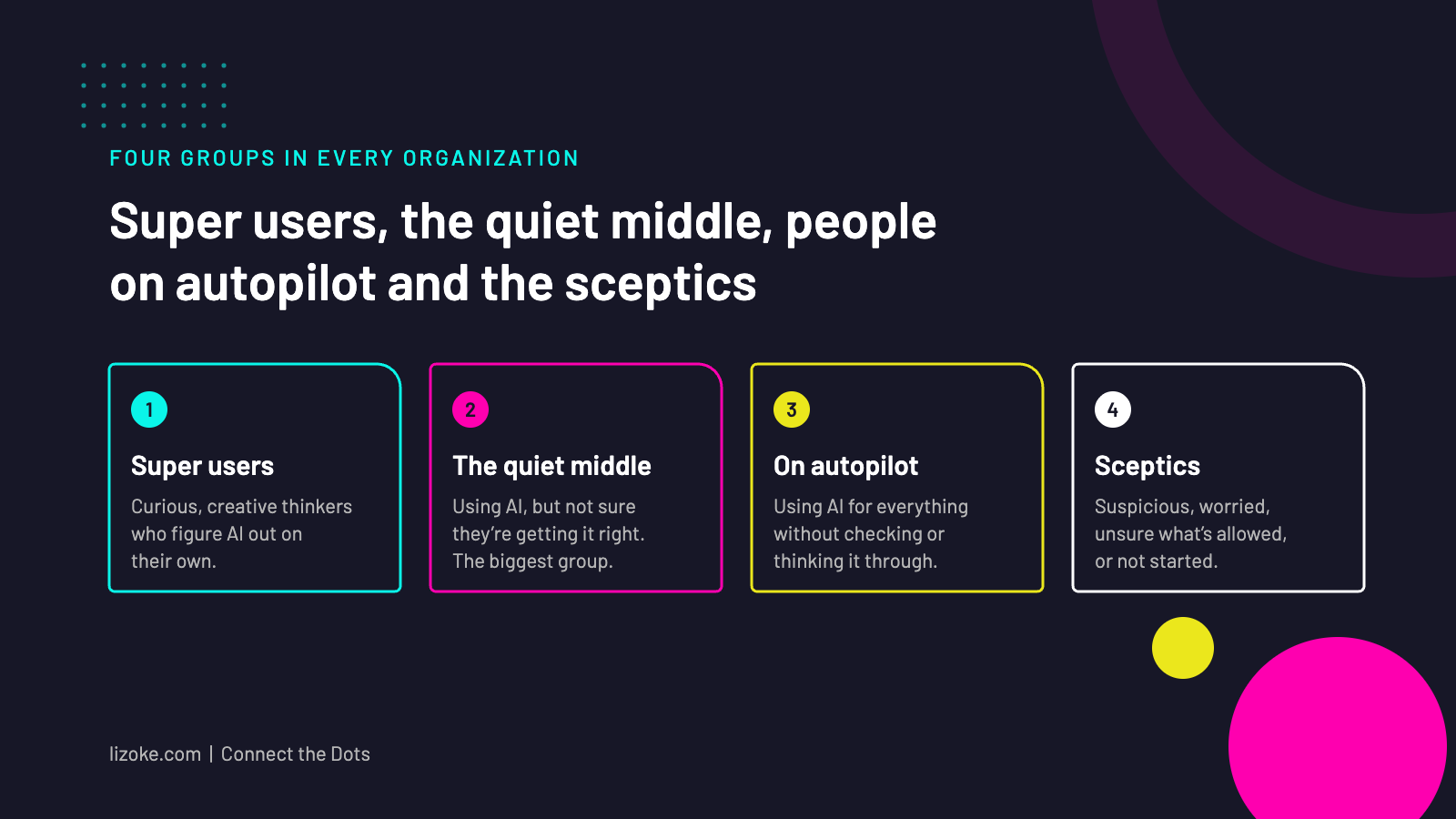
Who are the four kinds of AI users?
AI super users
Curious, creative thinkers who figure AI out on their own. They try things, find new uses every week and are flying with it.
The quiet middle
The biggest group. They use AI, but they’re not sure they’re using it the right way or getting the full benefit, and they’re not the type to go off and experiment on their own.
On autopilot
They use AI for everything, but they stop checking and thinking it through, so the work turns generic and their own voice fades.
Sceptics
Worried about their jobs, burned by a bad answer, unsure what’s allowed or simply haven’t started.
Why does the quiet middle matter so much?
Because it’s the biggest group, and the one leaders hear from least. After all, AI super users talk about AI constantly, and the people who won’t touch it are easy to spot. The quiet middle shows up in the adoption numbers as “using AI,” so everyone assumes they’re fine.
However, they often aren’t getting much from it. A Study.com report covered by TechRepublic found fewer than half of employees feel confident judging whether AI output is accurate and useful. A 2026 survey reported by HR Director Canada found 22% of professionals say AI makes them neither better nor faster. And OpenAI’s enterprise research found people saving more than 10 hours a week use about eight times more AI than those saving none. The gap isn’t only between users and non-users. It’s between people who know how to make AI work for their job and people who don’t.
Why can’t the quiet middle just copy the AI champions?
To begin with, some people think outside the box easily. For example, give them a new tool and they see uses everywhere. On the other hand, others find it genuinely hard to picture how AI fits their own work. Still, that’s not a skill gap or a motivation problem. Rather, it’s a different way of thinking, and it therefore needs a different kind of help.
For instance, an executive once asked me for “the five prompts that will help me with my job.” I understood the request; however, a list of prompts wasn’t the answer. Instead, the better question went back to him: you know your job better than anyone, so what do you need help with? Once he answered that, the right uses for AI became obvious, and he could start experimenting with the tool he already had.
Start with the grunt work, not the prompts.
How can AI champions help move the quiet middle forward?
Ask about the grunt work
Managers ask their team one question: “What grunt work don’t you want to do anymore?” The answers become your first AI tasks.
Turn the question back
Instead of handing people prompts, ask what they need help with in their own job. They know it best. Then help them try it.
Pair them with AI champions
Thirty minutes, one task. After all, seeing a colleague solve a real problem does more than any training deck.
Give them permission to experiment
A simple, one-page answer to “what am I allowed to use, and what can I put into it?” takes away the fear of doing it wrong.
Let AI champions show what good looks like
Share short examples of AI used well on your team’s real work, so people can check their own approach.
From my work
At one organization I work with, the biggest shift came when adoption moved closer to managers. Leadership set the direction, but managers translated it into their own team’s work.
We paired that with workshops built on each team’s real tasks, plus extra support for junior and frontline staff, who are often the quietest part of the quiet middle. After all, people learn faster from examples that look like their own job than from a company-wide email.
What about the people who won’t touch it?
Similarly, when I sit down with people who aren’t using AI, I rarely hear “I don’t care.” I hear “I tried it and it gave me something wrong,” “I don’t know what I’m allowed to put into it,” “I don’t have time to learn something new” and “If AI can do my job, what happens to me?” In other words, every one of those is reasonable, and none gets fixed by another company-wide email. Fortunately, the grunt-work question works here too: it starts with something they’d be glad to hand off, not something they’re afraid to lose.
How can AI champions help people on autopilot?
People on autopilot look like your best users, because they use AI all day. However, heavy use isn’t the same as good use. When nobody checks the output, emails miss the question that was asked and decks fall apart the moment someone asks “why?” So good AI champions model the habit: AI drafts, then a person reads it, checks it and makes it their own.
How do you turn super users into AI champions?
AI super users are your biggest asset; even so, they’re easy to burn out. They often become the unofficial help desk with no recognition for it, and some work around the rules with personal accounts. Workday’s research flags a lot of concealed AI use at work. Make them official AI champions: give them a real role (a short monthly show-and-tell, a shared library of what works), recognize it, and make sure your guidance covers what they’re already doing.
What are AI champions?
AI champions are colleagues who use AI well and help the people around them do the same. In most organizations, your super users are already doing this informally. Making the role official, with a little time set aside and some recognition, is one of the cheapest ways to move the quiet middle, because people learn best from a peer who does the same job.
What not to do
- Don’t hand out prompt lists and call it training. Prompts help once someone knows what they want AI to do for them.
- Don’t set usage targets. People will open the tool to hit the number and get nothing from it.
- Don’t rely on one training session. Training matters, but it has to be ongoing and tied to real work.
- Don’t mistake “using it” for “getting value from it.” That’s exactly how the quiet middle gets missed.
Try this next week. At your next team meeting, ask: “What’s one piece of grunt work you’d hand off tomorrow if you could?” Then write the answers down. Next, pick one and pair the person who said it with one of your AI champions for 30 minutes.
Keep reading
- The team-by-team guide to AI adoption (start here)
- How to measure AI ROI team by team
- AI for finance teams: a practical, job-by-job guide
- Not every team is ready for AI, and that’s OK
Frequently asked questions
What is the quiet middle in AI adoption?
It’s the large group of employees who use AI but aren’t sure they’re using it well or getting the full benefit, and who won’t experiment on their own. They count as “users” in adoption numbers, so they’re easy to overlook.
What is an AI super user, and how is it different from an AI champion?
A super user has made AI part of their everyday work and gets noticeably more out of it than colleagues. An AI champion is a super user with an official role helping others. Most teams have at least one person who could do it.
Why don’t prompt lists work for training?
Because the hard part isn’t wording a prompt. It’s knowing what you want AI to do for you. Starting with the work people want to hand off gets them there faster.
Why do some employees resist using AI?
Usually because of trust after a bad result, uncertainty about what’s allowed, lack of time to learn, or worry about their job. Each has a practical fix.
Should we make AI use mandatory?
I’d avoid usage targets. Set clear expectations for specific tasks instead, and support people as they learn.
Let’s connect the [ people ] dots
If you have super users flying, a quiet middle unsure of itself and colleagues standing still, my AI ROI Review maps where AI is working team by team and what it will take to bring everyone along.
Book a conversationSources: OpenAI enterprise AI report, via VentureBeat; Study.com workplace AI report, via TechRepublic, 2026; AI and humanity at work survey, via HR Director Canada, 2026; Workday AI at Work survey, 2026.