“Is our AI investment paying off?” It’s the question every leadership team is now being asked, and most can’t answer it with confidence. Not because AI isn’t helping, but because they’re measuring it in the wrong place. Here’s how to measure AI ROI where the work actually happens.
This article is part of my team-by-team guide to AI adoption.
After all, a single company-wide number blends the people who use AI every hour with the people who never open it. As a result, you end up with an average that describes nobody. The fix is to measure AI ROI where the work actually happens: team by team.
The measurement gap
Why is it so hard to measure AI ROI?
Three reasons come up again and again. First, the value is spread across hundreds of small tasks, not one big project. Gallup found the benefits of AI showing up mostly at the level of individual tasks. Second, use is uneven, so averages hide both your wins and your gaps. Third, organizations measure what’s easy (licences and logins) instead of what matters.
Meanwhile, the cost of not measuring is real. CloudZero’s 2026 survey found 78% of finance executives can’t fully connect AI spending to business outcomes, and teams that can’t measure are far more likely to hold back investment or cancel projects. Protiviti’s finance research found only 35% of finance leaders say they’re effective at measuring AI ROI.
What should you use to measure AI ROI instead of logins?
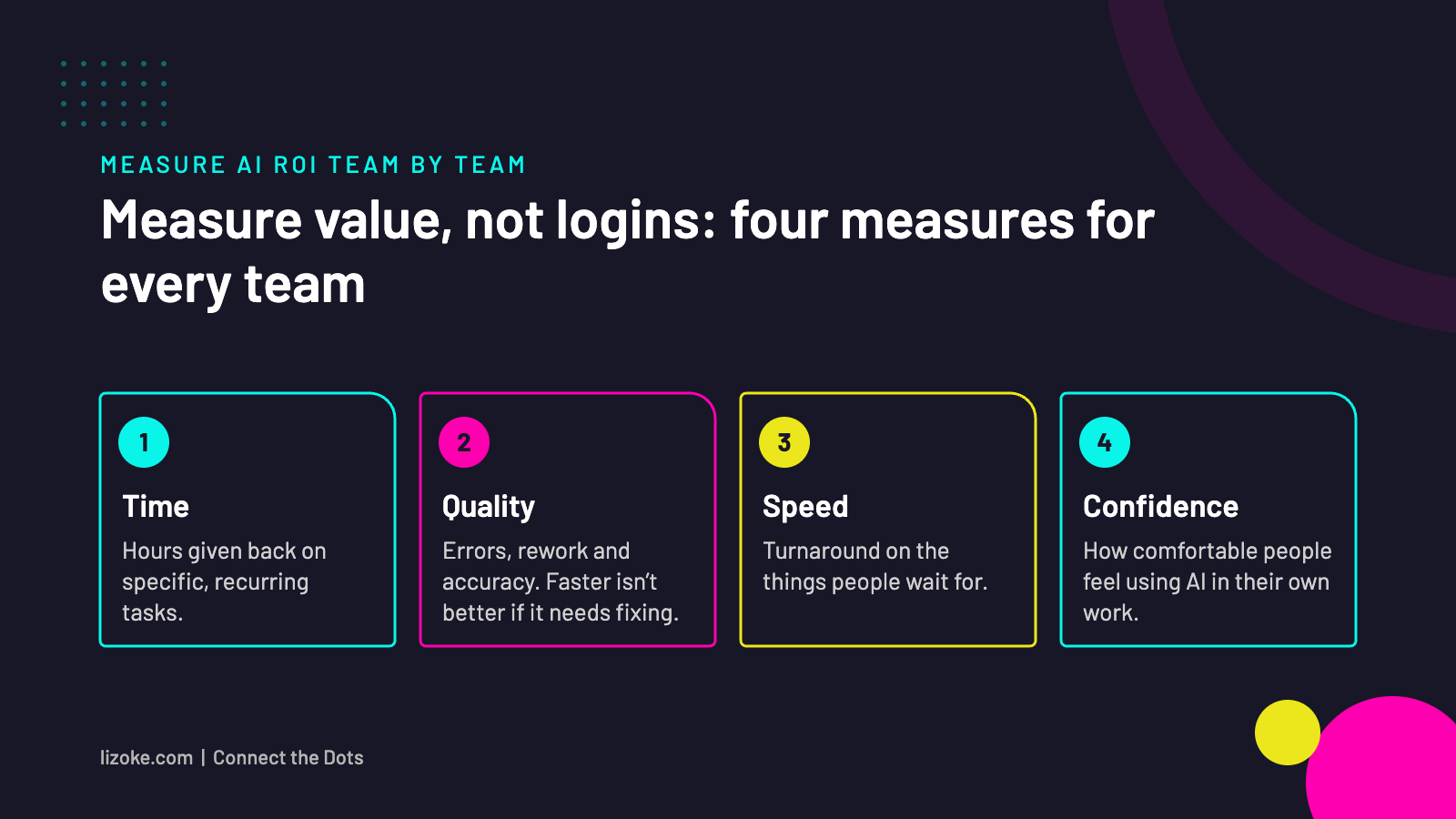
BCG’s advice is to measure value, not adoption. In practice, I therefore use four kinds of measures, chosen for each team:
Time
Hours given back on specific, recurring tasks. Measure the task, not the person.
Quality
Error rates, rework, accuracy and consistency. Faster isn’t better if it creates more fixing.
Speed
Turnaround times for things customers, clients or colleagues wait on.
Confidence
How comfortable people feel using AI for their work. It predicts whether the other three will last.
However, time alone undercounts the value. Research from Protiviti and LSE points out that better-quality work and lighter mental effort don’t show up as hours saved. That’s why quality and confidence also belong on the scorecard.
What does it look like to measure AI ROI team by team?
In short, every team gets a short list of measures that fit its work. Here are examples I’d start with:
| Team | Task to measure | What to track |
|---|---|---|
| Finance | Month-end reconciliations and variance commentary | Hours per close, errors caught, days to close |
| HR | Job postings and candidate screening | Time to post, time to shortlist, quality of hire |
| Marketing | First drafts of content and reports | Turnaround time, rounds of edits |
| Operations / front desk | Answering routine inquiries | Response time, inquiries handled, escalations |
| Leadership / EAs | Meeting prep, notes and follow-ups | Hours per week, follow-ups completed on time |
From my work
One leadership team I work with started the year asking a simple question: are people using AI? By the fall, the question had changed to a better one: where is AI creating capacity in each team?
So we stopped counting licences and prompts. Instead, success looks like less time on meeting notes, faster research before big projects, fewer manual handoffs between teams, and room to take on more work without adding admin headcount at the same pace.
How do you set a baseline to measure AI ROI?
First, keep it light. Before a team changes how it works, ask them to estimate how long the chosen task takes today and how often it needs fixing. After all, a rough, honest estimate is far better than no baseline. Then, after 30 days, ask again, and again after 90.
The one-page scorecard. For each team: the stage they’re at (have it, use it, build it in, prove it), one or two tasks, a before-and-after number for each, and one sentence on what’s next. If it doesn’t fit on a page, it won’t get updated.
What if you measure AI ROI and a team shows none?
In fact, that’s useful information, not failure. It usually means one of three things: the team isn’t really using AI yet, the task chosen isn’t a good fit, or the team needs support (training, clearer guidance, a better tool). The point of measuring team by team is that you can see which it is and act on it, instead of writing off AI for the whole organization.
Watch for the quiet middle here: the people who use AI but aren’t sure they’re getting it right. They count as “users,” so logins look healthy while the results stay flat. If a team’s numbers aren’t moving, ask them what grunt work they’d most like to hand off, and measure that.
Don’t ask if AI is working. Ask where it’s working, and for whom.
Keep reading
- The team-by-team guide to AI adoption (start here)
- Super users, the quiet middle and the people who won’t touch AI
- AI for finance teams: a practical, job-by-job guide
- Not every team is ready for AI, and that’s OK
Frequently asked questions
How do you calculate AI ROI?
For each team, compare the value of time saved, quality gained and speed improved against what you’re spending on tools, training and support. Start with a few specific tasks rather than trying to measure everything.
What are good AI ROI metrics?
Hours given back on specific tasks, error and rework rates, turnaround times and employee confidence. Avoid relying on logins or licence counts.
How long before AI shows ROI?
Simple, everyday uses can show results in 30 to 90 days. Deeper workflow changes and agents take longer. Measuring by team helps you see early wins.
Do small and mid-sized organizations need formal AI ROI tracking?
They need simple tracking. A one-page scorecard per team, updated quarterly, is enough to make good decisions about where to invest next.
Let’s connect the [ ROI ] dots
My AI ROI Review gives you a team-by-team picture of what AI is costing you, where it’s paying you back and where it isn’t yet, with a scorecard you can keep using.
Book a conversationSources: CloudZero finance survey, via IT Brief, 2026; Protiviti 2026 Global Finance Trends Survey, via CPA Practice Advisor; BCG, AI at Work 2026; Gallup, 2026; Protiviti and London School of Economics, 2026.