
Most organizations have already started AI adoption, and most are still looking for an AI adoption framework that works for everyone. The licences are bought, the policy is drafted (or about to be), and someone in leadership has said, “Everyone should be using this.” So the question I ask now isn’t “Should we adopt AI?” It’s this: is AI working for your whole organization, or just a few people?
In almost every organization, the honest answer is “a few people.” A few super users have rebuilt their week around AI. At the same time, a few people won’t touch it. Meanwhile, most sit in what I call the quiet middle: using AI, but not sure they’re doing it right. This guide explains why that happens, and how to make AI work for everyone, team by team and job by job.
Key takeaways
- AI adoption spreads person by person, not team by team, so company-wide numbers hide most of the story.
- Every organization has three groups: super users, the quiet middle and people not using AI. The quiet middle is the biggest and the most overlooked.
- Start with the grunt work, not the prompts. Ask each team what work they don’t want to do anymore.
- Map every team on four stages (have it, use it, build it in, prove it) and give each team its own next step.
- Measure value, not logins: time, quality, speed and confidence, team by team.
The uneven picture
Why is AI adoption so uneven inside organizations?
Because access isn’t the same as ability, and a tool rollout isn’t the same as a change in how work gets done. In fact, the research keeps landing in the same place. KPMG found that a small group of employees consistently gets better outcomes with AI, while most people see modest or inconsistent gains. Gallup reports that the benefits are showing up in individual tasks rather than in how the workplace runs. Meanwhile, a Protiviti and LSE study found employees with AI training adopt it at 93%, compared with 50% of those without.
Gallup also found that people use AI far more often when the tools fit their existing workflow, their manager supports it and the organization has clear policies (Gallup, 2026). In other words, AI adoption depends on conditions around each team, not just on the tool. That’s why it spreads person by person. The curious went first, and everyone else is somewhere between “I tried it once” and “I’m worried about what this means for my job.”
From my work
At one organization I’ve worked with this year, the three groups showed up almost exactly like this. A handful of power users were already deep into Copilot and Claude. Meanwhile, a bigger group was interested but unsure, and some people hadn’t really started.
So we stopped treating AI as something for a few selected users. Instead, everyone got the same quality access, and the real work became building confidence team by team. The business question never changed, though: can we take on more work without growing headcount at the same pace?
Who are the super users, the quiet middle and the people not using AI?
Super users
Curious, creative thinkers who figure AI out on their own and are flying with it.
The quiet middle
The biggest group. Using AI, but unsure they’re getting it right, and not the type to experiment on their own.
Not using it
Worried about their jobs, burned by a bad answer, unsure what’s allowed or simply not started.
Adoption numbers count the quiet middle as “using AI,” so leaders assume they’re fine. Often, though, they aren’t getting much from it. A Study.com report found fewer than half of employees feel confident judging whether AI output is accurate and useful. Some people see uses for AI everywhere; others find it genuinely hard to picture how it fits their own work. However, neither is better. They simply need different help, and the quiet middle is where most of the untapped value sits. I go deeper on all three groups in super users, the quiet middle and the people who won’t touch AI.
Where should AI adoption start? With the grunt work, not the prompts
An executive once asked me for “the five prompts that will help me with my job.” I understood the request, but a list of prompts wasn’t the answer. Instead, the better question went back to him: you know your job better than anyone, so what do you need help with? Once he answered that, the right uses for AI became obvious, and he could start experimenting with the tool he already had.
For managers, the starting question is just as simple: “What grunt work don’t you want to do anymore?” The team’s answers become the first training, the first workflows and, later, the first agents. It also gets people thinking about their own roles, which is exactly what moves the quiet middle.
Start with the grunt work, not the prompts.
The team-by-team AI adoption framework: have it, use it, build it in, prove it
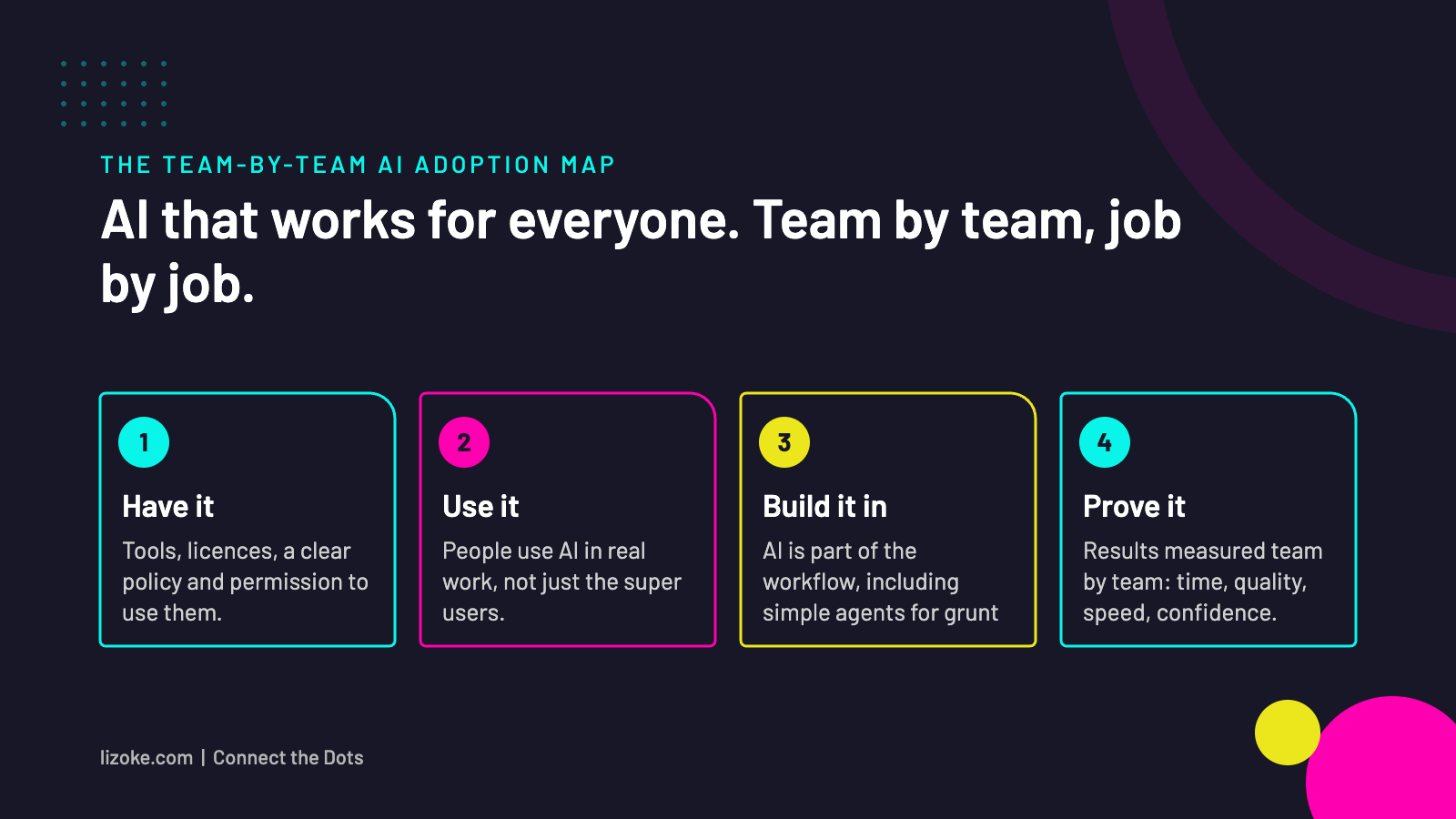
When I look at an organization, I don’t give it one AI score. Instead, I map each team against four stages:
- Have it. The tools are in place, there’s a clear policy, and people know they’re allowed to use them.
- Use it. People use AI regularly in their real work, not just the super users.
- Build it in. AI is part of the workflow, including simple agents that take on mundane, repeatable tasks.
- Prove it. Results are measured team by team: time, quality, speed and confidence.
As a result, the map does two things. First, it shows leaders where AI is really working (usually not where they assumed). Second, it turns a vague “we need more adoption” into a specific next step for each team.
What does AI adoption look like in each team?
Every team uses AI differently, so every team needs its own first task and its own measure. Here’s where I usually start.
Finance
Start with first-draft variance commentary, reconciliation checks and polite, consistent payment reminders. Then measure hours per month-end close and errors caught before review. For a role-by-role breakdown, see AI for finance teams: a practical, job-by-job guide.
HR and hiring
In HR, start with job postings, interview guides and summarizing policy questions. AI screening is where care matters most: it may be faster, but you have to ask whether it’s better. Measure time to post, time to shortlist and quality of hire.
Operations and front desk
For example, start with answering routine inquiries, shift notes and standard operating procedures written in plain language. Measure response times and how many questions get resolved without escalation.
Marketing
Similarly, start with first drafts, repurposing content across channels and summarizing campaign results. Measure turnaround time and rounds of edits, and keep a person on brand voice and facts.
From my work
At a large US professional services firm I work with, the marketing team spent the year making sure AI tools describe their experts accurately. For example, they rewrote one consultant’s bio page so it answered the questions clients actually ask.
A few months later, he mentioned in passing that new people had reached out because they found him through ChatGPT, Claude and Copilot. Nobody had tracked it, so the team only heard because he always asks, “How did you find me?” That’s also why the firm now wants to measure whether it’s named first in AI answers, not just mentioned.
Executive assistants and leadership
Finally, start with meeting prep, notes, follow-ups and turning long reports into one-page summaries. Measure hours given back each week and follow-ups completed on time.
How do you measure AI adoption and ROI team by team?
First, measure it where the work happens: by team. A company-wide number blends your super users with people who never log in, so it tells you almost nothing. BCG puts it simply: measure value, not adoption. Logins and licence counts tell you who has AI; however, they don’t tell you whether it’s helping.
For each team, I look at four kinds of measures: time given back on specific tasks, quality and error rates, speed on the things people wait for, and how confident people feel using AI. Time alone undercounts the value, because better-quality work and lighter mental effort don’t show up as hours saved. The full method, with a one-page scorecard, is in how to measure AI ROI team by team.
A quick test. Ask each team lead one question: “What’s one task AI does for your team every week now?” If the answer is clear and specific, that team is past “use it.” If the answer is “I think some people use it,” you’ve found where to start.
What if a team isn’t ready for AI?
That’s normal and, in fact, it’s okay. Teams do very different work, so they won’t all be ready at once. A team that isn’t ready is telling you what it needs: clearer guidance, a tidier process, an honest conversation about jobs or simply a quieter season. Invest where a team is ready now, prepare the ones that aren’t, and revisit both every quarter. More on that in not every team is ready for AI, and that’s OK.
When should AI adoption move from everyday tools to agents?
Agents are the next step, not the first one, because a team needs confidence first. Once a team uses AI confidently, the natural question is, “What could run on its own?” For most organizations, the best first agents handle the boring work: sorting inquiries, preparing first drafts of routine reports, chasing missing information and updating records. For that reason, my rule is simple: an agent prepares, a person decides. Anything that moves money or changes a record should have a human checkpoint.
What guardrails does AI adoption need?
- A one-page policy. Which tools are approved, what information can go in, and when a person must review the output.
- Data care. Keep confidential, client and personal information in approved tools only.
- Human review. AI drafts and summarizes; people decide, reply and own the result.
- Honest communication. Say clearly what AI is for in your organization, and what it isn’t for.
A 90-day AI adoption plan
- Days 1–30: map and ask. Place every team on the map, find your super users and ask each team what grunt work they don’t want to do anymore.
- Days 31–60: one task per team. Pair the quiet middle with super users on one real task each. Record a rough baseline for two or three measures.
- Days 61–90: measure and decide. Compare results, share what worked, and decide where to go deeper (including first agents) and where to wait.
Read the full series
- Super users, the quiet middle and the people who won’t touch AI
- How to measure AI ROI team by team
- AI for finance teams: a practical, job-by-job guide
- Not every team is ready for AI, and that’s OK
- BDC LIFT explained: funding for AI adoption in Canada
Frequently asked questions
About the approach
What is team-by-team AI adoption?
It’s an approach that looks at how each team uses AI, rather than measuring one company-wide number. Each team gets its own stage, its own next step and its own measures of success.
What is the quiet middle?
The large group of employees who use AI but aren’t sure they’re using it well or getting the full benefit, and who won’t experiment on their own. They count as users in adoption numbers, so they’re easy to overlook.
What are the biggest AI adoption challenges for companies?
Uneven use across people and teams, unclear guidance on what’s allowed, worry about jobs, messy processes and no clear way to measure results. Most of these are people and process problems, not technology problems.
Why isn’t company-wide AI adoption data enough?
Because it blends your heaviest users with people who don’t use AI at all. You can have a healthy average and still have whole teams getting nothing from it.
Getting started
How do I get employees to use AI?
Start with the work they want to get rid of, not with a list of prompts. Give people a simple policy, pair them with a super user on one real task, and measure the team rather than ranking individuals.
How do I know if a team is ready for AI?
Look for a clear, recurring task AI can help with, a team lead who supports it, and people who know what they’re allowed to use. If those are missing, start there.
When should we start using AI agents?
Once a team is using everyday AI tools confidently. Start with mundane, rule-based work, and keep a person in charge of anything that moves money or changes a record.
What is an AI ROI Review?
It’s my structured look at what your organization is already using, what it’s costing you, which teams are getting value and where AI could pay you back. You come away with a team-by-team map and clear next steps.
About the author. Liz Oke is a fractional CMO and AI adoption advisor, and the principal of lizoke Inc. in Toronto. She helps organizations across Canada and the US make AI work for everyone, team by team. She taught digital strategy at the University of Toronto School of Continuing Studies, developed and taught the Chartered Marketer program for the Canadian Marketing Association, and holds Anthropic certifications in building with Claude.
Let’s connect the [ AI ] dots
If AI is working for some of your people but not all of them, my AI ROI Review maps where it’s working team by team, what it’s costing you and what to do next. Practical, human first, no hype.
Book a conversationSources: Protiviti and London School of Economics, generational AI survey, 2026; KPMG, behaviours behind high-impact AI use, 2026; Gallup, rising AI adoption spurs workforce changes, 2026; Gallup, what separates AI adopters and holdouts, 2026; Study.com workplace AI report, via TechRepublic, 2026; BCG, AI at Work 2026. Last updated November 20, 2026.