One of my clients has a team that’s miles ahead with AI and another that has barely started. Leadership was worried the second team was “behind.” My answer surprised them: in fact, that’s normal, and it’s okay. Not every team is ready for AI at the same time, and pushing every team at the same pace is one of the fastest ways to waste your AI investment. AI readiness happens team by team, not all at once.
This article is part of my team-by-team guide to AI adoption.
Uneven by nature
Why does AI readiness differ from team to team?
Because teams do very different work, AI readiness varies widely. Some spend their day writing, analyzing and answering questions, which AI handles well. On the other hand, others work with physical things, live customers or specialized systems where everyday AI tools fit less naturally. Similarly, you can see the same pattern across whole industries: Statistics Canada data shows 42.3% of information and cultural businesses using AI to deliver their work, compared with 9.2% in construction.
In addition, AI readiness depends on the conditions around a team. Gallup’s research found people were much more likely to use AI often when the tools fit their existing workflows, their managers supported it and the organization had clear policies. However, take any of those away and adoption stalls, no matter how good the tool is.
A team that isn’t ready isn’t failing. It’s telling you what it needs.
What are the signs of AI readiness in a team?
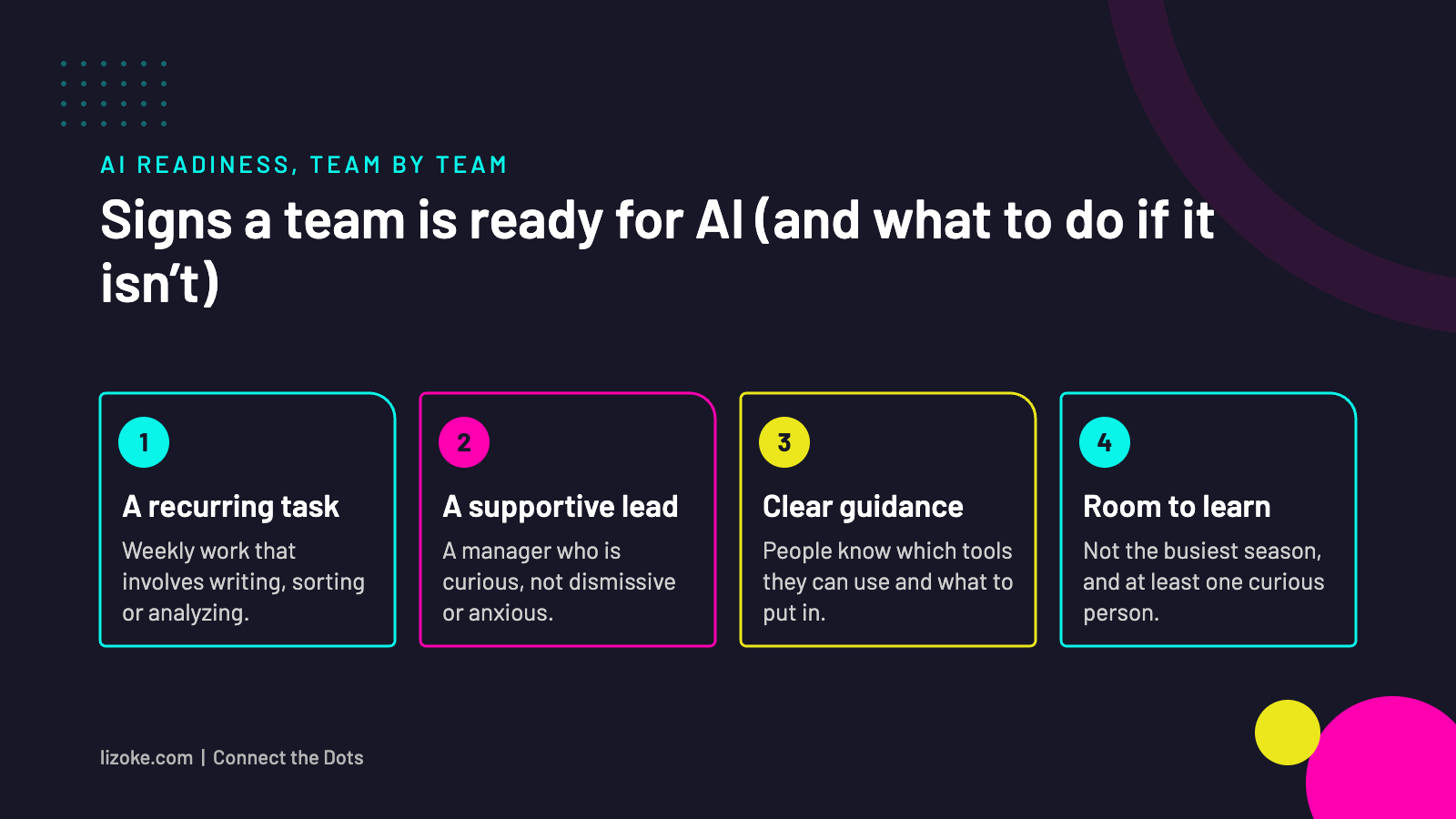
- A clear, recurring task. There’s work the team does every week that involves writing, summarizing, sorting or analyzing.
- A supportive lead. Their manager is curious, not dismissive or anxious.
- Permission and guidance. People know what tools they can use and what information they can put in.
- Some breathing room. The team isn’t in its busiest season or in the middle of another big change.
- At least one curious person. Someone willing to try things and share what works.
What are the signs of low AI readiness?
- The team is stretched to the limit and has no time to learn anything new.
- Its work relies on systems or data AI tools can’t safely reach yet.
- There’s real fear about jobs that hasn’t been talked about openly.
- Basic processes are unclear or inconsistent. After all, AI on top of a messy process just makes the mess faster.
From my work
Before rolling AI out to everyone, one organization I work with ran pilots in a few teams first. Those pilots answered a better question than “Can people use AI?” They showed where it actually helps: meeting notes, drafting, synthesis, research and analysis.
Then, when it came to agents, we chose fewer, better builds, starting with meeting notes. That’s because each build had to show a real operational benefit, not just prove that something could be automated.
How do you build AI readiness in a team that isn’t ready?
First, don’t ignore it, and don’t force it. Instead, give it a smaller, more useful next step. On the team-by-team map (have it, use it, build it in, prove it), a team that isn’t ready is usually still at “have it.” The work there is foundational:
Clear the basics
Make sure the team has access, a simple policy and a plain answer to “what am I allowed to do?”
Talk about the worry
Have an honest conversation about what AI is for in your organization and what it isn’t for.
Fix one process
Pick one messy, repetitive process and tidy it up. It will make AI far more useful later.
Borrow a win
Have a super user from another team show one relevant example. Seeing a peer use it does more than any training deck.
Doesn’t that leave some teams behind?
Only if you lose track of them, because AI readiness changes over time. Microsoft’s 2026 Work Trend Index found that in many cases employees are moving faster than the organizations around them. In other words, the real risk isn’t that one team is slower. It’s that leaders don’t know which teams are stuck, so they can’t help. Fortunately, mapping each team, and revisiting the map every quarter, solves that.
Readiness isn’t only about teams. Inside every team there are super users, people who won’t touch AI, and a quiet middle using it without knowing if they’re getting it right. Even so, a good first conversation works for all three: ask the team what grunt work they’d most like to get rid of. You’ll learn more about readiness from that answer than from any survey.
A simple rule. Invest where a team is ready to use AI now. Prepare the teams that aren’t. Revisit both every quarter. That’s how you get AI that works for everyone, without forcing anyone.
Keep reading
- The team-by-team guide to AI adoption (start here)
- Super users, the quiet middle and the people who won’t touch AI
- How to measure AI ROI team by team
- AI for finance teams: a practical, job-by-job guide
Frequently asked questions
What is an AI readiness assessment?
A structured look at whether a team or organization has what it needs to use AI well: suitable work, supportive leadership, clear guidance, workable data and processes, and capacity to learn.
Should every department use AI?
Eventually most will, in different ways and at different speeds. It’s better to sequence teams based on readiness than to roll out to everyone at once.
How long does it take a team to become AI-ready?
Often a few weeks for the basics: access, guidance and one well-chosen task. Teams with process or data issues may need a few months.
What if leadership wants everyone using AI now?
Show them a team-by-team map. It gives leaders a clear picture of progress and a plan for every team, which is usually what they really want.
Let’s connect the [ readiness ] dots
My AI ROI Review maps where each of your teams stands, which ones are ready to go further and what the others need first.
Book a conversationSources: Statistics Canada data, via The Hub, June 2026; Gallup research, via Allwork.Space, 2026; Microsoft 2026 Work Trend Index.