
AI adoption in Canada is finally taking off. However, a new Globe and Mail feature shows that the results aren’t keeping pace with the enthusiasm, and I think I know why. The chokepoints holding companies back aren’t really technical. They’re human, which means they’re fixable.
This is my response to “Canadian businesses are betting on AI to boost productivity. These chokepoints are getting in the way” by Vanmala Subramaniam, published in The Globe and Mail on November 20, 2026.
AI adoption in Canada, by the numbers
What are the biggest barriers to AI adoption in Canada?
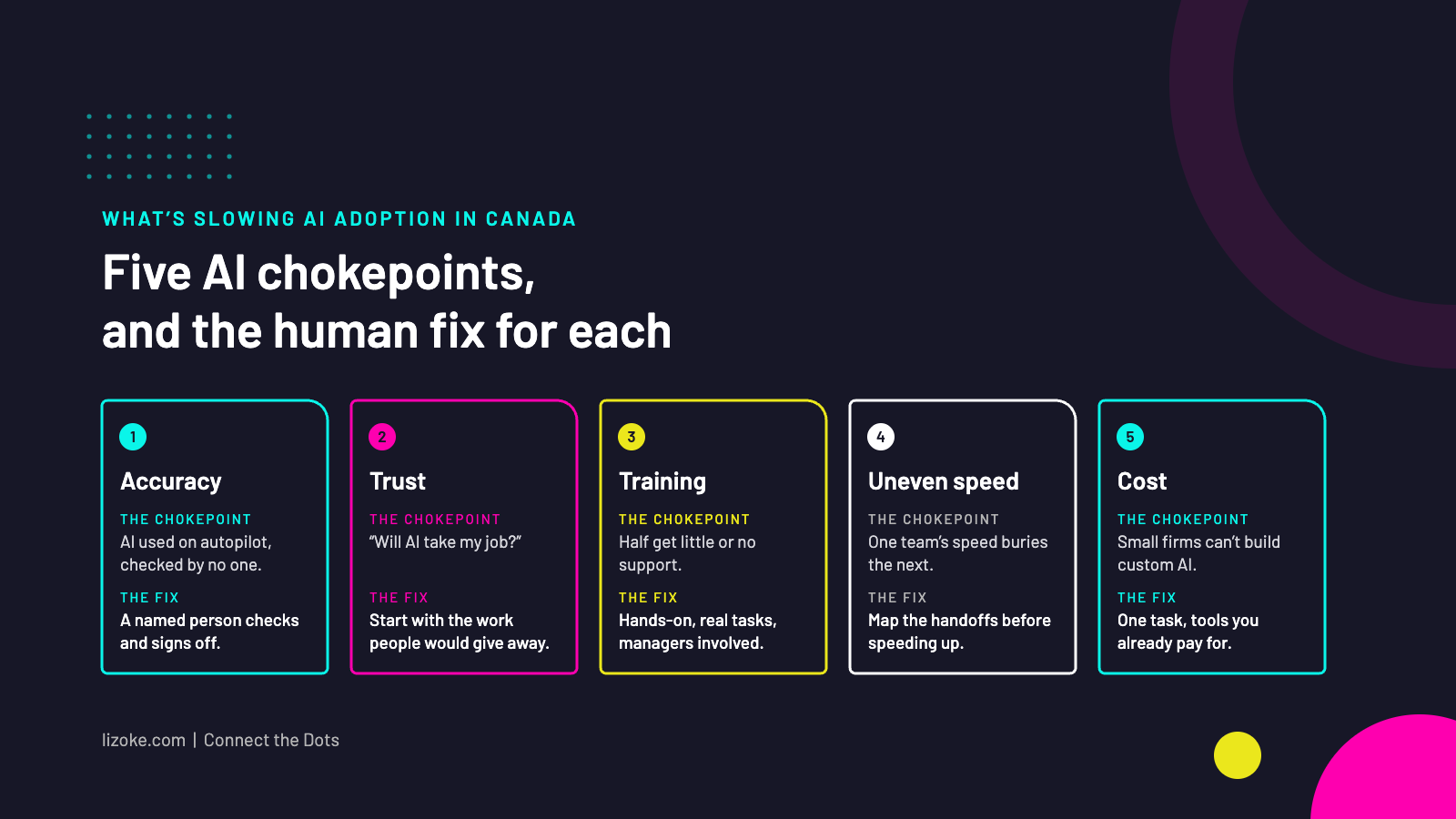
When the Globe talked to manufacturers, banks, a municipality and software companies, the same AI adoption challenges kept coming up: accuracy, trust, training and cost. In some workplaces, the rollout has been chaotic, wearing out employees and frustrating managers. I’d add a fifth: teams moving at different speeds.
None of this surprised me. In fact, it’s exactly what I see in the organizations I work with. Most companies treated AI as a tool to switch on. In reality, it’s a change in how people work, and that needs to be managed team by team, job by job.
Accuracy
AI can draft, but a named person checks the facts and signs off.
Trust
Start with the part of the job people would happily give away.
Training
Hands-on sessions on real tasks, with managers involved.
Uneven speed
Map the handoffs between teams before you speed any of them up.
Cost
One dreaded task, the AI you already pay for, and 30 days of tracking the hours saved.
Is accuracy really a technology problem?
Partly, yes. AI still gets things wrong. But look closely at the examples in the article. A marketing leader at a Vancouver software company described long AI-written strategies being sent to colleagues to review, noting that “it’s never been easier to produce something that sounds smart.” Similarly, a manager at a big bank said junior staff produce AI content that isn’t quite right, so managers now spend time fact-checking it.
That’s not a tool failure. Instead, it’s a habit failure. In every organization I work with, I see four groups: super users, the quiet middle, sceptics and people on autopilot. The autopilot group uses AI a lot, but without checking or thinking. As a result, the work slides toward mediocrity, and the cost lands on whoever has to read it.
From my work
I regularly get email replies that were clearly written by AI and never checked. For example, they ask me questions I already answered in my original message, because nobody actually read what I wrote. The AI drafted the reply, but no person did the thinking. So my rule is simple: AI can draft it, but a person reads the original and checks the answer before it goes out.
What to do: Set one simple rule for every team: AI can draft, but a named person reads the source, checks the facts and signs off. Then spot-check AI-assisted work in team meetings, and coach the people on autopilot rather than policing them.
Why don’t employees trust AI?
Because many of them think it’s coming for their job. The Globe quotes a municipal CIO in Ontario whose employee emailed him after reading about tech layoffs, asking whether using AI would cost her her job. Likewise, a survey of workers in four countries found that while most see AI as valuable, 40 per cent feel it makes them replaceable.
You can’t memo your way out of that fear. Therefore, I tell leaders never to sell AI as a way to cut jobs. Notably, one bank in the article said trust came easily for an internal assistant because it clearly made front-line jobs easier. Trust follows usefulness, not announcements.
Trust follows usefulness, not announcements.
What to do: Before any rollout, ask each team which part of their job they’d happily give away. Next, pick one of those tasks, set AI up to handle it, and let the results do the persuading. Also, say plainly what AI will and won’t be used for in your organization.
Is one AI training session enough?
No. More than half of Canadian workers surveyed said their employer did little or nothing to build their AI skills. Consequently, people teach themselves, and you end up with a few super users racing ahead while the quiet middle quietly guesses.
Good AI training for employees uses real tasks from their own jobs, involves their managers and keeps going after the launch. In my experience, a workshop built around someone’s actual Tuesday morning does more than a dozen generic webinars.
What to do: Replace one-off webinars with short, hands-on sessions built around each team’s real tasks. In addition, give managers a role in the follow-up, protect time for people to experiment, and refresh the training whenever the tools change.
What happens when teams adopt AI at different speeds?
This was the point in the article that hit closest to home. One executive described how hard it is for sales and marketing to absorb ten times the output just because engineering suddenly works ten times faster. In other words, AI that works for one team can swamp the next one.
That’s why I don’t judge AI adoption by company-wide usage numbers. The better question is whether AI is working for the whole organization, or just for some people.
What to do: Map the handoffs between teams before you speed any of them up. For example, if one team will soon produce three times the output, plan how the next team absorbs it, or automate that next step too.
Can small businesses in Canada afford AI adoption?
The article’s most honest voice may be an engineering manager at a small plastics manufacturer. Between learning a new tool, fitting it into the business and justifying the cost, it all felt like too much. Meanwhile, a big bank could afford to build its own AI tools and cut its usage costs dramatically.
Small and mid-sized businesses can’t do that, and they shouldn’t try. If you need help with the cost, programs like BDC LIFT are worth a look, although it’s a loan, not a grant.
What to do: Pick one dreaded task, use the AI already included in your Microsoft or Google licence, and track the hours it saves for 30 days. If it works, expand it to the next task. If it doesn’t, you’ve spent very little to find out.
What does this mean for AI adoption in Canada?
One CEO in the article said leaders need zero ego about these tools. I agree, and I’d add one thing: zero ego, plus a plan. Ottawa’s AI for All strategy counts how many businesses use AI. However, the number that matters to you is whether AI is working for everyone in your organization. That’s the real test of AI adoption in Canada.
What not to do
- Don’t sell AI as a way to cut jobs. People quietly resist anything they think is coming for them.
- Don’t measure logins. Track hours saved and work taken on instead.
- Don’t rely on one training session. The tools change, so the training has to keep going.
- Don’t speed up one team in isolation. Check whether the next team can keep up.
Try this next week. Ask each team one question: “Which part of your job would you happily give away?” Then pick one answer, try it with the AI you already have, and check back in 30 days.
Keep reading
- The team-by-team guide to AI adoption (start here)
- AI champions, super users and the quiet middle
- How to measure AI ROI team by team
- Not every team is ready for AI, and that’s OK
Frequently asked questions
Why is AI adoption in Canada slow to pay off?
Use is growing quickly, but many companies switched AI on without changing how work gets done. As a result, accuracy, trust, training and cost problems pile up. The fix is managing AI as a change in how people work, team by team.
What is Canada’s AI for All strategy?
It’s the federal government’s plan to raise AI adoption across businesses from about 12 per cent to 60 per cent by 2034, with funding for training, adoption and support for Canadian businesses.
What are the biggest AI adoption challenges for small businesses?
Time and cost. Small teams have to learn a tool, fit it into their work and justify the spend all at once. So start with one task, use the AI in tools you already pay for, and measure the hours saved.
How do you build employee trust in AI?
Start with the parts of the job people would happily give away, be clear about what AI will and won’t be used for, and never frame it as a way to cut jobs. Trust grows when people see AI make their own work easier.
How should companies train employees on AI?
Use short, hands-on sessions built on real tasks from each team, involve managers in the follow-up, and keep training going as the tools change. One webinar isn’t a training plan.
Let’s connect the [ people ] dots
Want to know where AI is actually creating value across your teams, and where it’s getting stuck? That’s what my AI ROI Review is for.
Book a conversationSources: The Globe and Mail, November 20, 2026, citing CPA Canada, Statistics Canada, CIRA and Employment Hero research.